16 August 2025
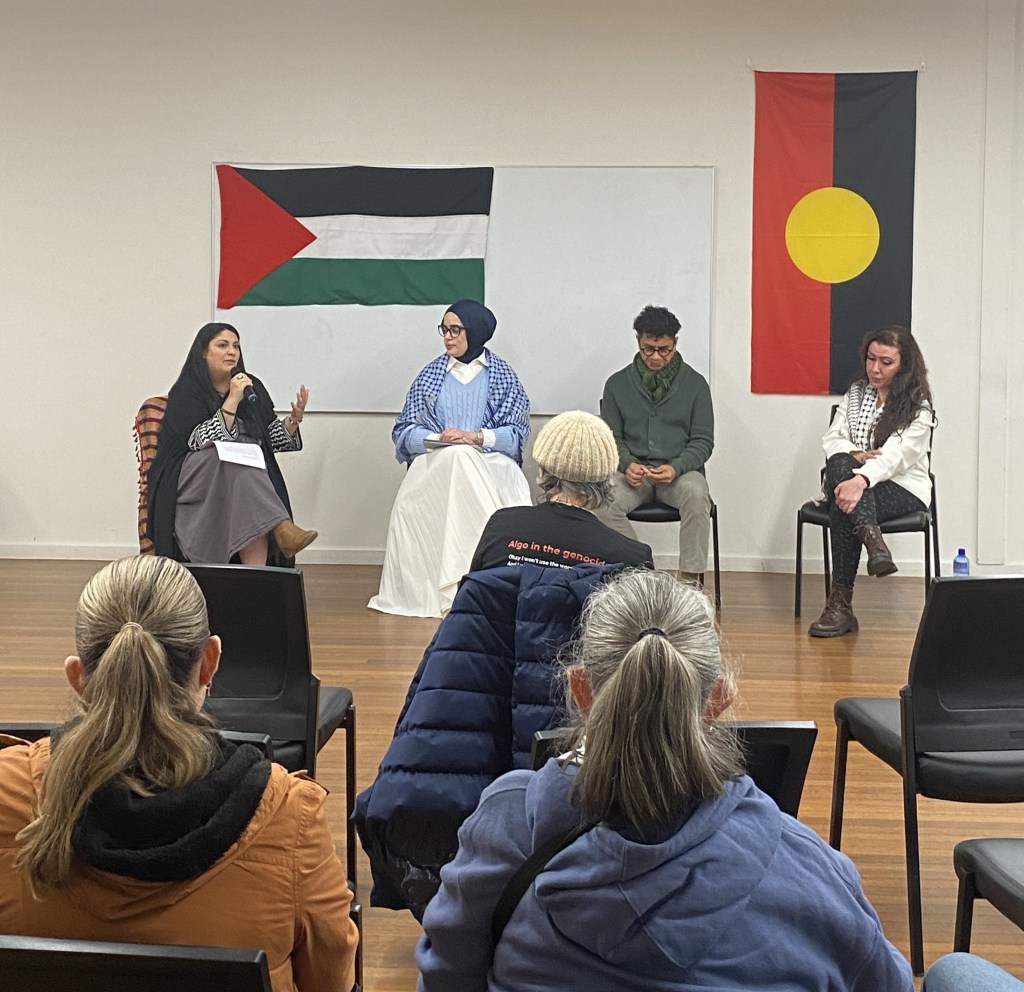
On 16 August 2025, community members came together for Grief in the Times of Genocide – a grassroots initiative offering a safe, collective space to reflect, share, and navigate grief under conditions of ongoing colonial violence. In light of the pain, rage, and heartbreak caused by genocide and occupation, the event was both a sanctuary and an act of resistance.
We reminded ourselves that strength is not just standing tall, unshaken. Strength is also vulnerability. Strength is crying. Strength is naming our pain. Strength is choosing to feel when the coloniser wants us numb and broken. They want us isolated, disconnected, unable to rise. As Assala Sayara, one of the panellists of Palestinian heritage, said, ancestors were never helpless. They felt despair, but they resisted. And so do we.
Moderated with sensitivity and care, the gathering centred on the truth that grief is not an individual matter, but a communal experience – deeply tied to history, culture, faith, and survival. The panellists, drawing on their diverse experiences in trauma recovery, counselling, activism, and community health, spoke about intergenerational trauma, collective distress, faith as a protective factor, somatic practices, and practical strategies for resilience.
But beyond clinical or theoretical frameworks, what emerged was a raw and urgent truth: grief itself is resistance.
Intergenerational Trauma
Intergenerational trauma is something we inherit often without even realising it- patterns of pain, fear, and resilience passed down through generations. It can be uncomfortable, even frightening, to confront this reality, because to do so is to admit that we are living under oppression. Denial might feel easier, but it only buries the trauma deeper. The work lies in acknowledgment: seeing the pain for what it is, allowing ourselves to feel it fully, and consciously transforming it. This is not a one-time act – it is an ongoing process, a lifelong practice of understanding, healing, and reclaiming agency over our lives and our collective history.
Strength and Vulnerability
One of the strongest themes of the evening was the relationship between strength and vulnerability. In dominant Western frameworks, strength is often imagined as standing alone – brave, unbroken, and unyielding in the face of crisis. Vulnerability, by contrast, is treated as weakness.
But as the discussion made clear, this view is deeply flawed. Strength cannot exist without vulnerability. To feel pain, to grieve, to weep, to be shaken – none of these things make a person weak. On the contrary, they reveal a depth of humanity that the oppressor seeks to erase. Vulnerability, when held in community, transforms into resilience.
Palestinians have carried grief for more than 70 years under occupation. Gaza, long before October 7, was already under siege – already suffering. Yet Gaza continued to exist. The very act of enduring while feeling pain is an act of strength.
This perspective unsettles the coloniser, because the coloniser wants the oppressed to become numb, silent, and disconnected. They seek to break people by isolating them, by convincing them that their pain must be hidden or that it is too heavy to carry. But acknowledging pain, instead of hiding it, becomes a form of resistance.
Helplessness and Resistance
A recurring insight was that it is normal to feel helpless under conditions of oppression, but it is not acceptable to become helpless. Colonisers design systems that keep people immobilised, unable to get out of bed, stripped of agency. But history teaches otherwise. Our ancestors felt despair, yet they were not helpless. They resisted, again and again.
To feel helpless is part of being human. To remain helpless is to surrender – and surrender is exactly what the oppressor wants.
Palestinian Culture Beyond Struggle
The event also challenged the narrative that Palestinians are defined only by their suffering. Yes, Palestinians are known internationally for their displacement, oppression, and resistance. But before the occupation, Palestinians were and remain descendants of the Canaanites – an ancient people deeply rooted in the land.
Beyond resilience, Palestinians have an immense cultural heritage to share with the world: cuisine, music, language, poetry, art, storytelling, and history. These are not secondary to resistance – they are integral to it. They affirm that Palestine is not only grief and trauma, but also beauty, creativity, and generosity.
Palestine for All
Speakers affirmed a truth too often obscured: Palestine has always been for everyone – Jews, Christians, and Muslims. The struggle is not against Judaism, but against Zionist occupation and the displacement of Palestinians from their land.
This perspective is particularly important when teaching children and young people. Protecting them by hiding the truth is not protection – it is disempowerment. Children naturally have a strong moral compass, uncorrupted by political manipulation or media distortion. When they learn the truth about history, justice, and international law, they often grasp it with clarity.
Children should be taught that people once lived together in harmony, and that displacement was caused not by faith differences, but by colonial projects. They should learn why international law was created, how “israel” continues to violate it, and how many countries refuse to hold it accountable.
When adults withhold these truths “to protect children,” they deny them agency, limit their humanity, and restrict their moral development. Presenting facts allows children to make ethical choices, and more often than not, they will choose justice.
Allies and Responsibility
The discussion also addressed the role of allies. For white allies in particular, it is not helpful to centre shame or guilt. Individuals today are not responsible for what colonisers in the past did. But they are responsible for their own actions now.
The message was clear: transform guilt into meaningful action. Solidarity cannot be performative—it must be lived.
Faith as Resistance
Faith and spirituality were consistently described as protective factors in the face of genocide and oppression. Faith is not simply private belief—it is survival, resilience, and resistance.
Participants discussed how even phrases like Allahu Akbar (“God is the Greatest”) – a phrase long used by Muslims has been hijacked, weaponised, and demonised by Western narratives. To reclaim and normalise such expressions is itself an act of resistance.
Faith teaches dignity, equality, and justice. Islam teaches us that no white person is superior to a black person, and no black person superior to a white person- the only distinction is action. Faith demands that when we witness injustice, we resist it: with our hands if we can, with our words if we cannot, and at the very least with our hearts.
For many, without faith, survival in the face of colonial violence would not be possible.
Routine, Community, and Collective Survival
Another theme was the protective power of routine and communal practices. Research shows that keeping to routine, even in extreme conditions, helps people stay alive. When practised collectively, routines provide immense protection.
Community connection is central. We cannot survive alone – human beings are not designed to endure isolation. Collective healing practices, cultural traditions, and shared rituals are protective factors that guard against despair.
At the same time, communal power can feel overwhelming. Grieving together, holding one another’s pain, is heavy. Yet this shared burden is also what sustains life.
Grief as Resistance
In closing, the gathering returned to a central truth: grief itself is resistance. To grieve is to refuse numbness. To feel pain is to affirm our humanity. To stand together in mourning is to reject erasure.
Colonisers may seek to gaslight the oppressed out of their experience, questioning their motives, denying their reality, and erasing their stories. But to gather in grief is to insist on survival. To connect in vulnerability is to defy domination.
Grief in the Times of Genocide was not only a community event – it was a declaration. It affirmed that faith, culture, community, vulnerability, and routine are not weaknesses, but the very foundations of survival. They are the roots of resistance. The event concluded with a call to action. Having recognised that grief must be transformed, both for those oppressed and their allies, what will our subsequent actions be?
Guided by moderator Paz Roman, a counsellor and community development worker supporting newly arrived Palestinian refugees, the session foregrounded community-led responses to grief. The panel brought together diverse expertise and lived experience:
- Rula Khalafawi – trauma-informed yoga coach, Community Educator with NSW Refugee Health Service and activist.
- Rafik Tanious – counsellor with 30+ years of experience working across education, mental health, and social services, with a strong background in trauma recovery.
- Assala Sayara – counsellor, social worker, social justice activist, orator, storyteller and PhD student.
With gratitude, Families for Palestine acknowledge the panellists for sharing their time, expertise, and care with the community.

 Families for Palestine
Leave a comment