“Putting the human in human rights.”
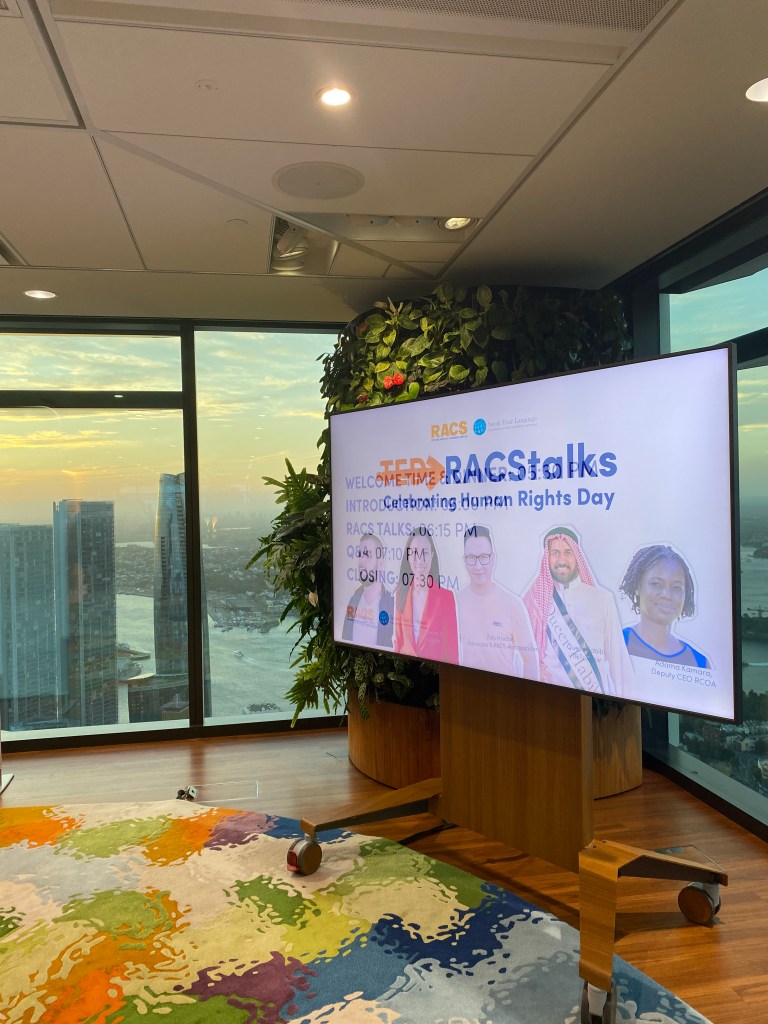
That’s how Adama Kamara — a former Sierra Leone refugee and now a leader at the Refugee Council of Australia — opened her story. Families for Palestine attended a special event by Refugee Advice & Casework Service (RACS) to commemorate Human Rights Day.
Angry at how refugees were being demonised in the media, Adama chose to turn that anger into action. In 2014, she initiated what would become the multi-award-winning Refugee Camp in My Neighbourhood project — a powerful, community-led response grounded in dignity, truth and lived experience.
Co-designed by people from refugee backgrounds and grassroots organisations, the project invites participants to walk in the footsteps of refugees and people seeking asylum through a guided, simulated experience.
You don’t just hear the story — you feel it.
Tours were led by guides with lived experience, sharing what it’s like to flee your home, seek safety, and rebuild your life in Australia.
A community project. A collective vision. A decade of impact.
IMPACT (2014–2025):
👥 16,414 total visitors
🎒 10,000+ school students
🌍 207 tour guides employed from 30+ countries
This is what happens when lived experience leads the way.
Tu Le, the next speaker from a Vietnamese background, a lawyer and community advocate and a mother, was speaking to the tension many children of refugees grow up with — deep gratitude for safety in Australia, alongside the responsibility to question systems that still exclude others.
She shared how her parents, like many refugee families, taught their children to be grateful, to work hard, and not to complain. Gratitude was a survival lesson — a way to honour the safety they had fought to find.
But Tu Le challenged the idea that gratitude should ever mean silence.
She reminded us that representation alone isn’t enough. Diversity without decision-making power is symbolic, not transformative. When people from refugee and migrant backgrounds are present but not heard, nothing structurally changes.
Her message was clear: while hard work matters, policies are what ultimately decide who is protected, who belongs, and who gets a future. And if lived-experience voices are missing from those policy spaces, injustice is quietly reinforced.
Tu Le’s call was not to reject gratitude — but to pair it with courage.
To ask whose stories are still unheard, whose safety is still negotiable, and what each of us is willing to do to move diversity from appearance into action.
Other wonderful speakers on the evening were:
Queer Habibi, Ambassador for the RACS LGBTQI+ Safety Program, spoke of finding safety in Australia to live as his authentic self, while still carrying the pain of rejection from home — a reminder that safety is not just legal, but deeply personal.
Fadi Chalouhy shared the “miracle” of becoming the first — and still only — stateless person to arrive in Australia on a skilled visa. But he was clear: there are millions like him. The question is why pathways remain closed — and how we open them.
And Zaki Haidari — Human Rights Hero and refugee rights campaigner — spoke of enforced silence under cruel asylum policies, unable to speak out until citizenship finally gave him safety. Now, he speaks so others won’t have to wait as long.
Together, their messages meet at the same truth. Storytelling humanises, but systems decide outcomes. Lived experience must not only be shared — it must shape policy. Because policies determine who is safe, who belongs, and whose future is protected.
Adama’s theme has come full circle. Each story we heard put the human in human rights. If more Australians truly heard these stories, perhaps we could build a fairer, more just, and more compassionate society for all.
 Families for Palestine
Leave a comment