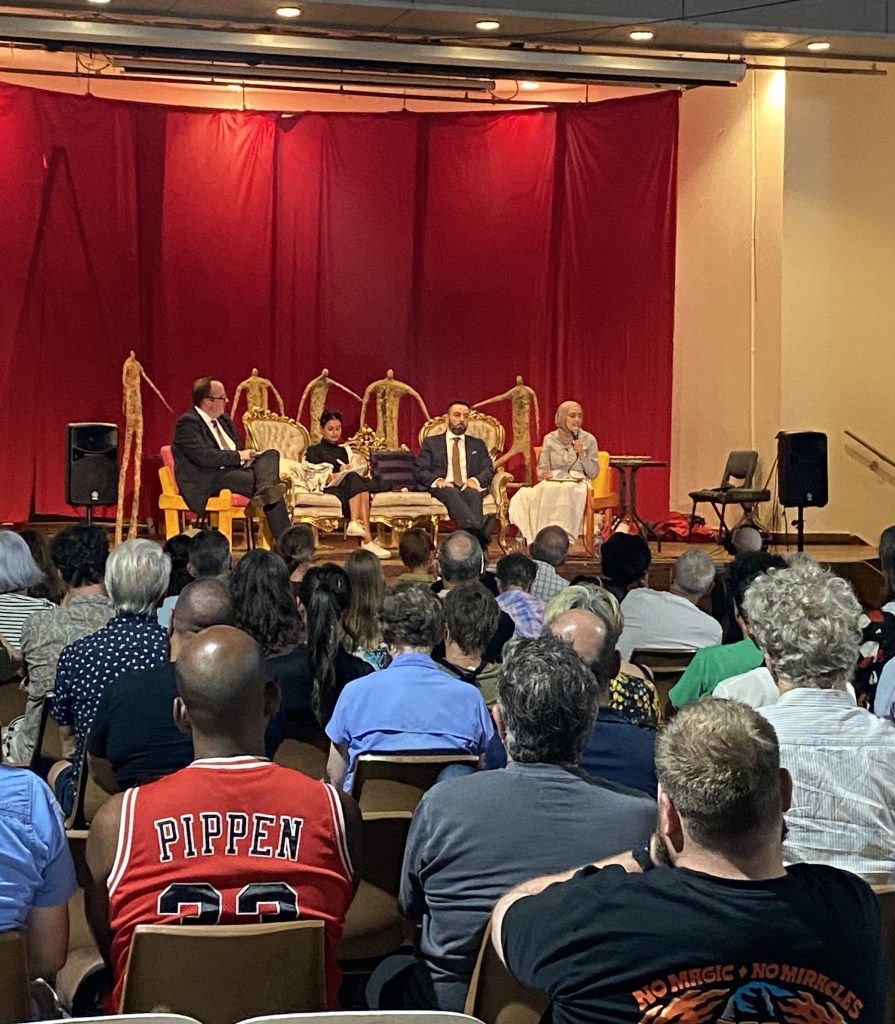
We attended this panel at Addison Road Community Organisation on 28 January. It was moderated by Amal Naser, with Hannah Thomas, Nick Hanna and Timothy Roberts from the NSW Council for Civil Liberties on the panel. And honestly, it left us unsettled in the way things should leave you unsettled when you’re paying attention.
Uncle Dave and Aunty Lizzie opened the meeting with an Acknowledgement of Country, and it mattered. Uncle Dave spoke about the original resistance on this land – smoke used to warn other clans of danger, communities living side by side, and permission always sought before crossing or using another clan’s land. Aunty Lizzie spoke about the terrorist attack on her people in Boorloo, and the authorities’ shameful response to it. It was a reminder that the new so-called anti-hate laws aren’t about stopping harm – they’re about control.
What struck us most in this discussion was how intentional all of this is.
These laws weren’t rushed through in January 2026 by accident. They were designed that way. Quiet months, distracted public, minimal scrutiny. And while they’re clearly aimed at the Palestinian solidarity movement right now, no one in the room pretended it stops there. History tells us it never does. Once the machinery is built, it gets reused. Climate activists. Union organisers. First Nations communities. Anyone deemed disruptive, loud, or inconvenient to the smooth functioning of this imperial colony called Australia.
One of the most alarming shifts is the expanded power handed to the Immigration Minister. Visas can now be cancelled using extremely broad discretion, so vague it’s almost immune to legal challenge. Decisions can be justified through elastic interpretations of “hate speech”, a term that currently has no clear, stable definition. When asked directly whether criticising Israel could fall under these laws, the Federal Attorney-General and Penny Wong refuse to give a straight answer. Not because they don’t know how to answer, but because they don’t want to. Ambiguity is the point. It leaves space for police interpretation, selective enforcement, and fear to do the rest.
Three years ago, the idea that criticising Israel could lead to criminal charges would’ve sounded absurd. Today, it’s a real possibility. That’s the speed of the shift we’re living through.
We also talked about ASIO, not as some neutral protector of public safety, but as a political tool built for surveillance. This isn’t theoretical. Climate activists were previously labelled the greatest threat to national security. There’s no reason to think the Palestinian movement won’t be next, if it isn’t already.
And yet, the message wasn’t despair. It was resistance.
The core argument was simple and uncomfortable: if we collectively refuse the idea that criticising Israel or Zionism is unlawful, and keep saying it anyway, the state cannot arrest everyone. Mass defiance doesn’t just happen in the streets; it shapes what becomes legally defensible. The more people push back publicly, the easier it becomes to challenge these laws in court.
Lawyers will fight in courtrooms over constitutional validity, but they can’t do it alone. The public has to make noise. Unions have to apply pressure. Large NGOs, community organisations, anyone with resources or reach has a responsibility to speak. Judges may never admit it, but public sentiment matters. Overwhelming opposition creates the conditions for the “right” legal decisions to become possible.
There was also a hard but necessary reminder: those with privilege need to carry more risk. If you can afford arrest, if your visa status is secure, if your job won’t disappear overnight, then your voice matters even more. And do it wisely. Get a lawyer before you need one, not after you’re locked up. Prepared resistance is stronger than reactive resistance.
This is new legal territory. No one can say with certainty yet what will be deemed unlawful and what won’t. That clarity will only come when people are charged and cases move through the courts. Until then, the uncertainty itself is being used as a weapon.
Another point that slipped under the radar but shouldn’t have: Gonski is now involved in developing the antisemitism education package for schools. This is the same figure who wants keffiyehs and watermelon symbols banned. It doesn’t take much imagination to picture what that “education” will look like, or who it will target.
The reminder at the end stayed with us. Albanese, Minns, MPs — they work for us. We elected them. Their salaries come from public money. If we don’t organise, if we don’t apply pressure, if we don’t accept some level of sacrifice, two things are inevitable. These laws will expand, and Australia will become increasingly unliveable for Muslims and for anyone active in the Palestine movement.
People power matters. Public opinion matters. These laws came in through political pressure, and they can be undone the same way. The path forward is collective resistance alongside legal challenge. They push. We push back. And we don’t stop until the laws are reversed.
Deep thanks to the panellists and organisers for creating and holding space for such a necessary conversation.
 Families for Palestine
Leave a comment