The Return is a powerful theatrical experience written and directed by Ala’a Al Qaisi.
In its first moment, The Return offers only a silhouette and an upward gaze, a wordless ache that settles before the story even starts. Then we hear a father supplicating to the clouds for his murdered daughters, begging for their return, clinging to the belief that they might come back.
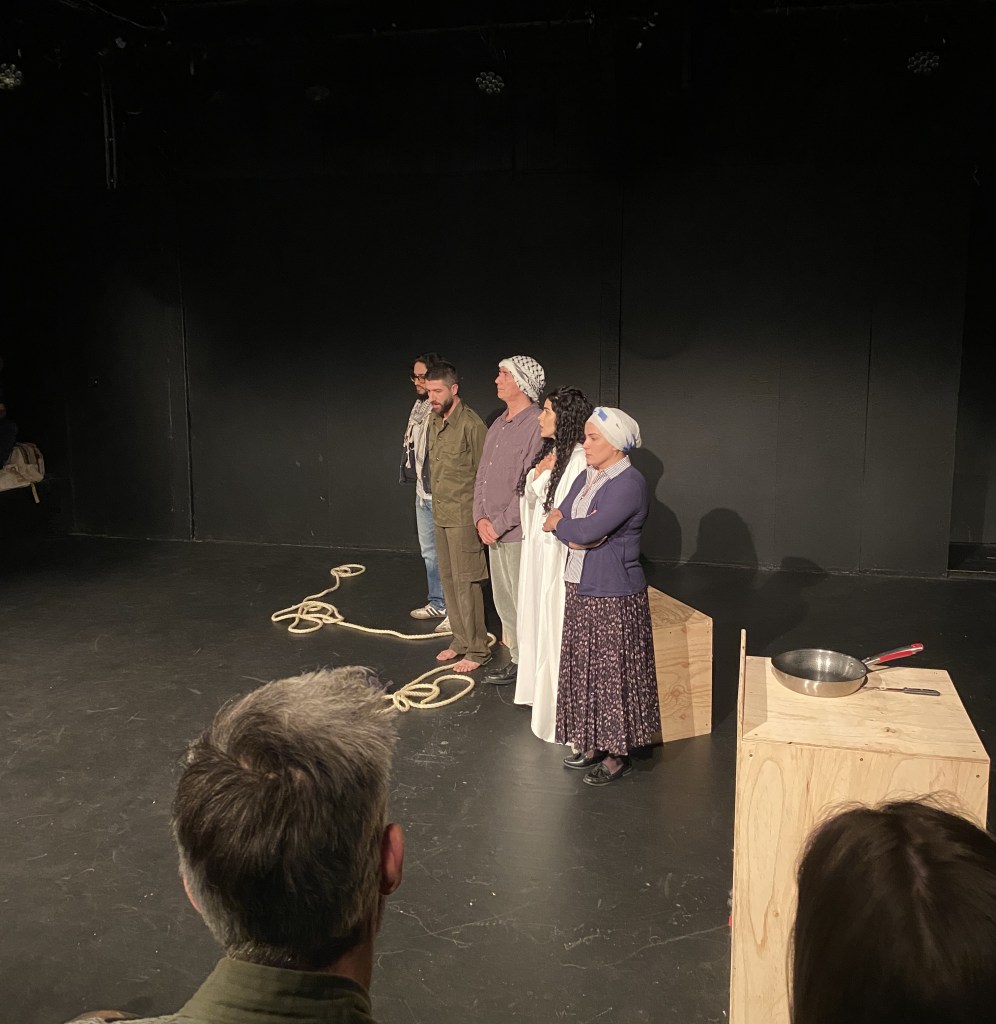
The Return follows Marwan, a grieving father in war-torn Gaza who waits for his martyred daughters to descend from the clouds. When a mysterious stranger appears, their encounter opens a passage into a dreamlike world where memory, grief, and faith intertwine. As the boundaries between life and death blur, Marwan is guided by his daughter’s spirit into a confrontation with guilt, humanity, and the possibility of redemption.
Sergio Silva (Marwan) delivered a staggering performance, transmitting grief, love, and unbearable longing with such raw honesty that you could feel it in your bones. With the longest stage presence, he carried the weight of the narrative in what felt like a single breath: steady, dignified, and deeply human. Even in his devastation, he showed a father willing to sit face-to-face with the man who killed his daughters and listen. It was haunting.
Rami Saaid’s character (The Man) is the quiet doorway through which the audience enters the world of the play. He represents the collective grief of Gaza, grounds the story in realism, mirrors Marwan’s loss, and sets the emotional tone for the spiritual journey that follows.
Ala’a Al Qaisi (Rozan) embodied Rozan’s spirit with an ethereal calmness that softened every scene she entered. As the martyred daughter returning to her father, Aviv, and even Sarah in dreams, she was the play’s moral and emotional anchor. There was no anger in her portrayal, only acceptance, compassion, and a deep desire to ease her father’s suffering and guide Aviv toward redemption.
Mohammed El Kesm (Aviv) delivered the most unsettling performance. As the “israeli” soldier responsible for the deaths of Rozan, her sister, and 17 others, he walked the line between perpetrator and broken human being. You despise him for what he has done – yet cannot ignore the torment consuming him. His hallucinations, his deteriorating mental health, the haunting vision of his grandmother trying to suffocate him – all blurred the boundaries between guilt, dream, and spiritual reckoning. Mohammed made it nearly impossible to tell whether we were witnessing a nightmare or entering a shared metaphysical space where souls confront the truth.
Ahlam Hijazi (Sarah) had perhaps the most challenging role, and her commitment was extraordinary. Her portrayal of a woman consumed by supremacist ideology – convinced she is divinely entitled to the land beneath her – was chilling and deeply uncomfortable to watch. The intensity with which she embodied this hatred made her almost unbearable, which is precisely what the role demanded. If Aviv had flickers of humanity left, Sarah was the embodiment of a worldview that has extinguished its own soul. Ahlam played her with terrifying conviction.
The play included several striking instances of symbolism, each adding depth to the story and the characters’ emotional journeys.
The play uses smell, adding a layer to its emotional impact. Rozan’s ethereal fragrance, noticeable only after her death, reflects the otherworldly clarity of her spirit, while Aviv regains his sense of smell only in her presence, marking a rare moment of human connection and awakening. Conversely, his inability to eat without being reminded of the flesh he has taken underscores the weight of guilt and the alienation wrought by violence, making scent a haunting bridge between the living and the dead.
One of the most striking instances of symbolism occurs when Marwan tells Aviv he is ‘pregnant’ with his daughters and allows him to touch his stomach, forcing Aviv to physically and emotionally confront the lives he has destroyed and the innocence he has taken — a visceral embodiment of accountability.
The tug-of-war scene symbolically embodies the moral and emotional pull between the characters — Aviv is torn between guilt, denial, and the possibility of redemption, while Marwan is caught between rage, grief, and the difficult path toward forgiveness.
Alongside this, the venue’s proximity to low-flying airplanes added an unplanned but powerful effect: the constant roar overhead mirrored the warplanes above Gaza, intensifying the tension and immersing the audience further into the characters’ world.
The play was profoundly thought-provoking, heavy, and deeply emotional. We went in expecting a straightforward retelling of real events, but it was far more than that – a surreal, poetic exploration of grief, loss, and the human consequences of genocide. What stayed with us most was the lingering tension between life and death, guilt and redemption, and the haunting, fragile hope threaded through even the darkest moments.
Many involved in the production found it deeply personal. For several cast and crew members, Palestine is not just a story – it is family, heritage, blood. They worked on this project while the genocide was still unfolding, bringing their own grief, fear, and connection into every rehearsal and performance. The play became a way to process and attempt healing, but it also raised a haunting question: how does one heal while the horror is still happening?
It’s the kind of theatre that unsettles, moves, and refuses to be forgotten.
Sincere gratitude to the cast, crew, sponsors, and volunteers – and everyone who brought this powerful play to life.
 Families for Palestine
Leave a comment