This has become one of our favourite quotes of all time, and the one we have kept turning to over the past three years.
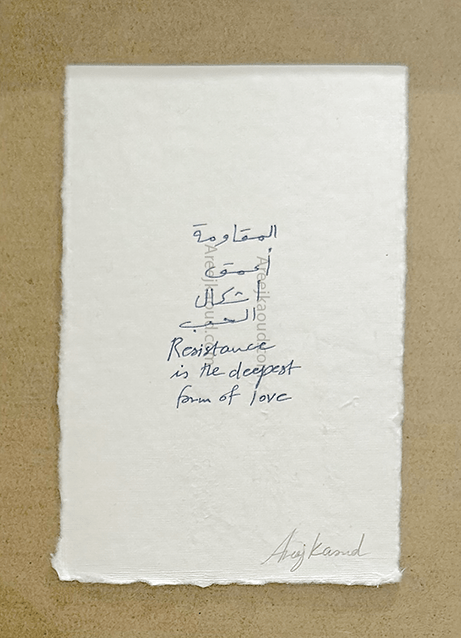
“Resistance Is the Deepest Form of Love” is a piece of art by Areej (see image below), a Palestinian visual artist, created to emphasise love as the foundation of resistance. Her artwork explores how resistance grows from a protective, nurturing, and self-sacrificing kind of love. It is deeply driven by a sense of belonging and a desire to preserve the land. In Areej’s words: “It is the deepest form of love because the stronger the resistance, the more entrenched and steady its roots are.”
Over the 23–24 May weekend at the Sydney Writers’ Festival, the theme of love came up twice. First, at “Silenced” – a sold-out session at Carriageworks featuring Randa Abdel-Fattah, Jan Fran, Antoinette Lattouf, and Michael Mohammed Ahmad. And then again, at the panel called “The Love Fest,” celebrating the launch of “Love”, a new anthology created by the Sweatshop Literacy Movement, a Western Sydney collective dedicated to empowering culturally diverse, migrant, and Indigenous writers.
In the “Silenced” session, amidst the critique of a punitive system, the panellists reminded us of what fuels the resistance: hope and love. It was an unforgettable, vital hour that reminded everyone in the room why we must refuse to be quiet. Because if we do, eventually, they will come for the rest of us. Silencing journalists, book critics, academics, and writers ultimately means silencing readers and silencing thoughts.
“The Love Fest” showed that when a crowd of different voices is brought together into a single book, love becomes a shared journey. When we fight for each other’s stories and stand together against erasure, we are practising the deepest form of love there is. For Shirley Le, the editor of “Love”, love is not a passive emotion; it is an active, collaborative labour.
Living proof of this radical love came when Natalia Figueroa Barroso inscribed our copy of her debut novel, “Hailstones fell without rain”, with the words “Hasta la victoria siempre” (“Until victory, always!”). By invoking this famous phrase by Che Guevara, Natalia connected her literature directly to a history of real-world survival and resistance. Historically, Che Guevara explicitly linked revolution to love; he believed that a genuine love for humanity and justice must be the driving force behind any fight for liberation.
Love is the true foundation of standing up for what is right. True resistance comes from a protective and self-sacrificing kind of love, driven by a sense of justice, a feeling of belonging, and a longing for homeland – a collective gift of love that moves us to act.
Looking back at this entire weekend at Carriageworks, all of these pieces – “Silenced”, “The Love Fest” and Natalia’s inscription – bring us to one undeniable truth:
Resistance is truly the deepest form of love.
 Families for Palestine
Leave a comment